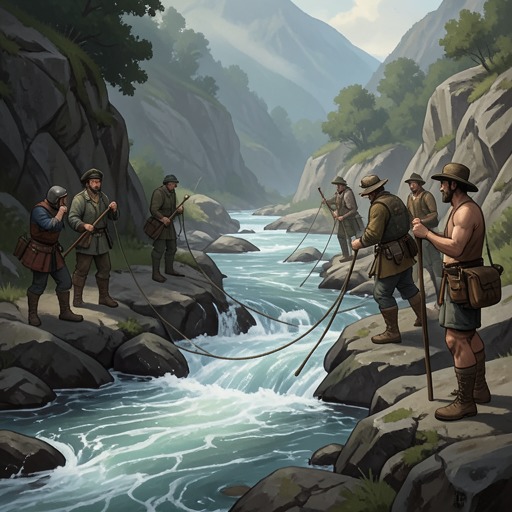
“Cross the great stream”
I Ching“Cross the great stream” is a Yijing expression for entering a dangerous undertaking, not a command to advance regardless of circumstance. Its force depends on the hexagram around it: the image can endorse a difficult passage when conditions favor action, while elsewhere the text warns against undertaking it. The commentary identifies the Yellow River as a possible historical referent, linking the phrase’s perilous passage to the long-delayed campaign of King Wu against the Shang.
Meaning and Use
The commentary explains that going through a great stream may signify hazardous enterprises or the encounter with great difficulties, without referring to any one specific undertaking. The expression therefore works both as a concrete image of crossing and as a judgment about facing risk. Whether such a crossing is beneficial depends on the surrounding counsel rather than on the phrase alone.
In Hsü, sincerity is declared, firmness brings good fortune, and crossing the great stream is said to be advantageous. Yet the hexagram’s lesson is not reckless action: strength confronted by peril should wait until success is assured. The first line depicts waiting at the distant border, maintaining one’s purpose without error; the second places the wait nearer the stream, on its sand, where a small injury from criticism does not prevent eventual good fortune. The crossing thus belongs to a sequence of restraint and preparation, not an impulse to force the passage.
Contrasting Judgments
The phrase does not carry an unconditional promise of success. In Sung, a person may be sincere in a dispute and still encounter opposition and obstruction. Apprehensive caution can bring good fortune, but pursuing the contention to its bitter end brings evil; seeing the great man is advantageous, while crossing the great stream is not. The contrast makes the image a practical test of judgment: difficulty alone does not make a venture worthy, and persistence can become harmful when it ignores the conditions of the moment.
By contrast, Thung Zăn places the union of men in the remote districts of the country and declares progress and success. There crossing the great stream is advantageous, alongside maintaining the superior man’s firm correctness. Set against Sung’s prohibition, this occurrence shows how the expression’s counsel changes with the situation represented by the hexagram: a demanding passage may serve collective progress in one setting and compound danger in another.
Historical Interpretation
The commentary suggests that the stream may most naturally be understood as the Yellow River, while acknowledging that the phrase need not have a specific reference. On this reading, the image points toward the revolutionary movement against the Yin dynasty and its tyrant, culminating in King Wu’s crossing of the river in 1122 BC. The commentary calls that passage one of the greatest deeds in Chinese history and emphasizes that it followed long waiting, until success seemed assured.
That historical association sharpens the expression’s central tension. Crossing is momentous precisely because it is dangerous; the appropriate response is neither permanent retreat nor premature advance, but action undertaken when the time has come. The hexagram examples preserve the distinction: Hsü stresses waiting before the decisive passage, Thung Zăn permits it in pursuit of progress, and Sung counsels against it in a dispute that should not be driven to an extreme.
Translation and Interpretation
The translator warns that a literal rendering of the Yijing can fail to communicate its meaning. Chinese written characters, in his account, are symbols of ideas rather than representations of spoken words, and their composition conveys what the writer thinks rather than simply transcribing what the writer would say. Translation therefore requires entering into the author’s thought and expressing it intelligibly, sometimes supplying a word or two that the original leaves implicit. That freedom is limited by the obligation to represent the original as exactly and concisely as possible.
The phrase’s different judgments illustrate why context matters. The translator describes the hexagram texts as short, enigmatic essays on moral, social, and political themes, grounded in six-line figures. King Wen interprets each hexagram as a whole, sometimes indicating a course of action and its good or bad fortune; the Duke of Zhou interprets the individual lines through symbolic illustrations. The whole-hexagram judgment should accord with the combined significance of its lines, while each line’s application varies according to the hexagram’s name and subject. “Cross the great stream” consequently has no fixed verdict detached from its setting: its meaning emerges through the relation between the image, the hexagram, and the advice surrounding it.